GitHub Actions: ARM runners are 1.5x faster for tilemaker (Nov 2, 2026)
(Return to the homepage.)
Disclosure: Claude Code ran the experiments described here, and Claude wrote the post's initial draft.
The Hiker Atlas map is built on GitHub Actions, using the free runners you get for a public repo. Their stated specs are the same whether you ask for x64 (ubuntu-latest) or ARM (ubuntu-24.04-arm): 4 vCPUs and 16 GB of RAM.
It turns out those 4 vCPUs aren't the same thing.
The x64 lottery
I added a step that logs the hardware each job lands on. ubuntu-latest isn't one machine, it's a pool. In one run, the 9 layer jobs landed on four different Azure VM types:
D4ads_v5: AMD EPYC 7763D4ads_v6: AMD EPYC 9V74D4ads_v7: AMD EPYC 9V45D4ds_v5: Intel Xeon 8370C
You don't get to pick, and it matters. The same tilemaker job takes about 1.5x longer on an older v5 than on a v7:
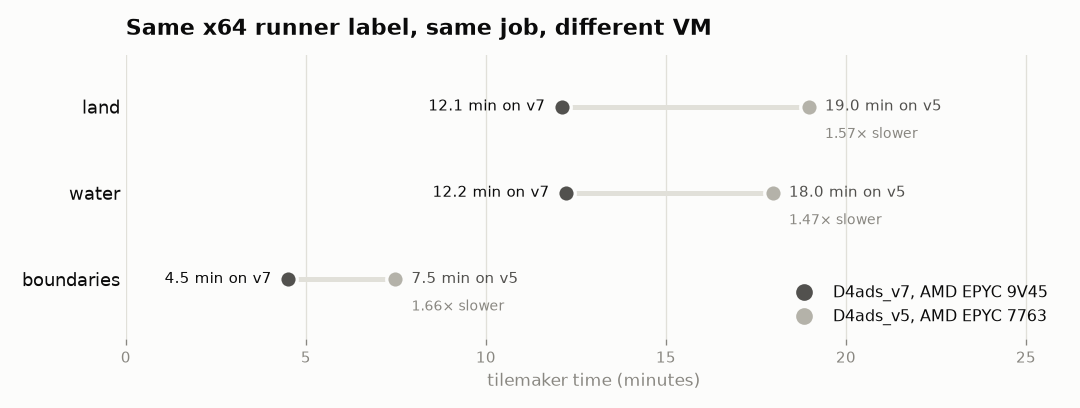
This explained something that had been bugging me. The same layer would take wildly different times from one build to the next: water took anywhere from 15 to 39 minutes. The slowest job decides how long the whole build takes, so a build's time mostly came down to which VMs it drew.
All of these have 4 vCPUs, but that's 2 physical cores with 2 hyperthreads each.
ARM
GitHub's ARM runners also have 4 vCPUs, but they're 4 full Neoverse-N2 cores.
I built all 9 North America layers on both runner types, side by side:
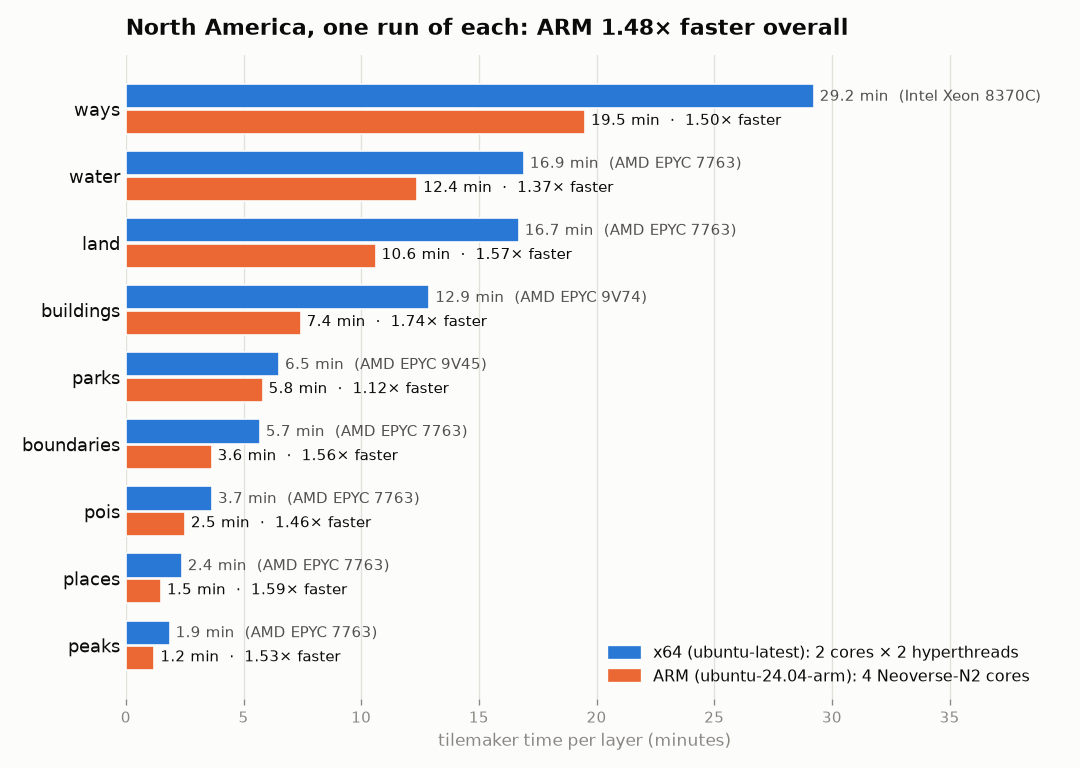
ARM was faster on every layer, 1.48x overall. The ways layer, which decides when the layer stage finishes, dropped from 29 minutes to under 20.
Look at parks: only 1.12x. Its x64 job happened to draw a v7, the fastest x64 VM. Against the slower v5s, ARM was 1.4–1.6x faster.
The other thing I noticed: all 9 ARM jobs landed on the same VM type, D4pds_v6, and so has every ARM job I've checked since. So builds aren't just faster, they're more predictable.
Caveats
This was one run of each. With the x64 lottery in play, the exact numbers will move around. But it wasn't close, so I switched every job in the pipeline to ubuntu-24.04-arm.
If you're running something CPU-heavy on GitHub's free runners, try the ARM ones.